
Po-Kuei Chuang: Building Social Trust and Turning NIMBY Facilities into Local Assets
Po-Kuei Chuang, General Manager of Taya’s Power & Communications Business Group, pointed out that Taiwan’s renewable energy development is facing a gap between policy targets and actual performance. In 2025, renewable energy accounted for only 13.3% of total energy generation, compared with the government’s 20% target. At the same time, the surge in AI computing power has created enormous demand for electricity, posing a major challenge to Taiwan’s energy transition. Key structural bottlenecks include difficulties in land acquisition and the “Not In My Backyard” (NIMBY) effect caused by insufficient public acceptance.
Chuang emphasized that “social trust is more important than power generation capacity.” The key to overcoming the final mile is to shift local residents from feeling that they are being sacrificed to becoming beneficiaries of shared interests. He cited Taya’s Zhiguang Fishery-Solar Integration and Solar-plus-Storage Project in Cigu District, Tainan, as an example. With aquaculture as the priority, Taya has reduced rental costs and guaranteed existing fishermen priority in leasing, while introducing smart water-quality monitoring and traceability systems. This has created a win-win-win model encompassing power generation, aquaculture, and local prosperity.
In addition, energy storage systems play a critical role in strengthening grid resilience in response to the intermittent nature of renewable energy. During the April 3 Hualien earthquake, Taya’s solar-plus-storage system released energy within one second to stabilize grid frequency, successfully helping prevent a nationwide blackout. Chuang concluded that only through transparent information, local communication, and benefit sharing can NIMBY facilities be transformed into local assets, building strong social trust and paving the way toward a sustainable net-zero future.
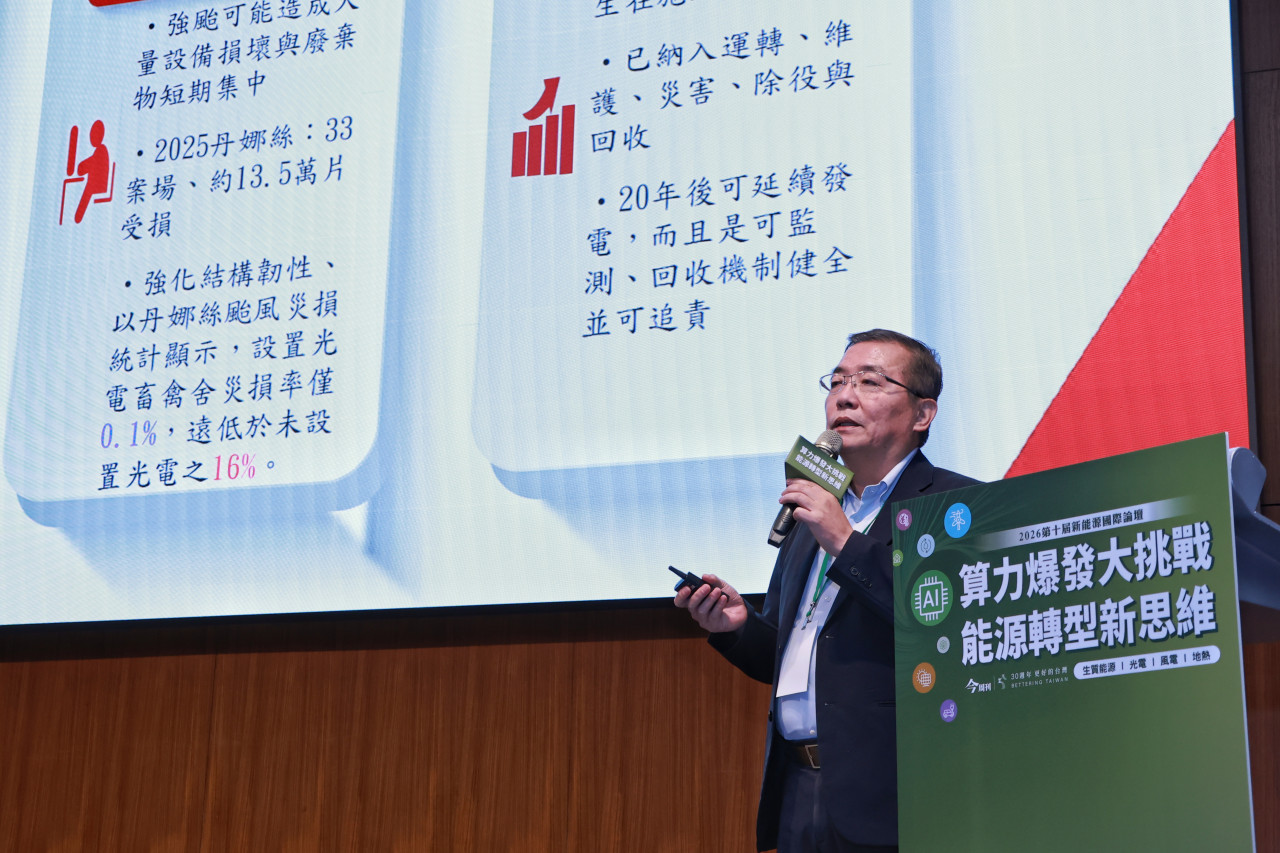
(Taya Power & Communications Business Group General Manager Po-Kuei Chuang emphasized that local communication is key to green energy development, turning NIMBY facilities into local assets. Photo by Liu Hsien-Chang.)
Chia-Chin Tsai: Breaking the False Dichotomy Between Farmland and Energy Development
Chia-Chin Tsai, Chairman of BJC Energy, pointed out that the rapid growth of semiconductors and AI computing power has created enormous demand for low-carbon electricity. However, “having electricity does not necessarily mean having the green power required by industry.” Taiwan is facing a structural conflict between insufficient green power supply and farmland protection.
Tsai noted that policy discussions have often fallen into the false dichotomy of “developing solar power versus protecting agriculture.” In reality, “the fact that farmland remains does not mean agriculture remains.” The true challenges facing rural areas include an aging population, labor shortages, and declining production capacity due to a lack of economic incentives. Therefore, land policy should shift from simply protecting the amount of farmland to maximizing the overall value of land through data-driven scientific classification.
He proposed a new concept of “regional agricultural-energy coexistence,” suggesting that the traditional requirement for agriculture and energy generation to coexist on the exact same piece of land should be reconsidered. Instead, within the same region, 60% to 70% could be designated as high-efficiency agricultural zones and 30% to 40% as high-efficiency green energy zones, allowing both agricultural productivity and power generation efficiency to reach their respective potential.
Taiwan could also draw on Germany’s experience by transforming the revenue from long-term corporate green power purchase agreements (CPPAs) into 20- to 30-year “development annuities” for rural communities, supporting local long-term care, encouraging young people to return home, and upgrading agriculture. Tsai emphasized that turning the energy industry into capital for sustainable rural development and creating a positive cycle of “agriculture × energy × semiconductors” will be an essential source of Taiwan’s competitiveness in the next stage.
Wei-Tse Chang: From “Made in Taiwan” to “Powered by Taiwan”
Wei-Tse Chang, CEO of United Renewable Energy, stated that amid the explosive growth of AI computing power and the global push for decarbonization, energy is no longer simply an operating cost. It has become a strategic core determining industrial competitiveness and national security. As international technology giants increasingly incorporate low-carbon electricity into their supply-chain standards, Taiwan’s energy industry is undergoing a critical transformation—from traditional “Made in Taiwan” toward “Powered by Taiwan,” driven by green energy.
Chang noted that, in response to NVIDIA founder Jensen Huang’s observation that “the source of the AI revolution is electricity,” United Renewable Energy has in recent years partnered with Sino-American Silicon Products to invest in solar module manufacturing facilities in the United States. This directly addresses the strong demand for local green power from AI data centers in the U.S. and demonstrates Taiwan’s ability to move beyond product exports toward global localized manufacturing and operations.
Faced with the stringent requirement of 24/7 uninterrupted production in advanced semiconductor manufacturing, United Renewable Energy draws on 30 years of international energy-operation experience to provide total solutions covering solar modules, energy storage systems, green power wheeling, and solar-plus-storage integration.
Through peak/off-peak energy dispatch, demand management, and smart microgrid applications using both front-of-the-meter and behind-the-meter energy storage, the company can help enterprises reduce electricity costs and power-supply risks while enhancing energy resilience during extreme weather or grid disruptions. With robust green energy infrastructure as a strong foundation, renewable energy can help power Taiwan’s competitiveness in the global AI era.
Hui-Ping Lee: New Opportunities for Smart Green Energy Amid the Need for Stable Power Supply
Hui-Ping Lee, CEO of HAI-LIP Electronics, stated that AI is changing the world, but its fuel is not only chips—the more fundamental requirement is electricity. With the rapid development of generative AI, semiconductors, and electric vehicles, a large AI data center can consume as much electricity as a mid-sized city. The world has officially entered the “electricity era.”
In response to the enormous demand for stable power supply, Taiwan cannot rely on a single energy source. Instead, it needs a diversified energy mix and must upgrade conventional solar power into an AI-enabled smart green energy platform that can be “seen, managed, and controlled.”
Lee pointed out that renewable energy has evolved from simply being a carbon-reduction tool into a key indicator of national competitiveness that integrates energy security, grid resilience, and intelligent management. HAI-LIP Electronics has expanded from electromechanical integration and photovoltaic EPC into AI-powered smart green energy, actively applying AI to fault prediction, optimal power-generation strategies, equipment diagnostics, and unmanned inspections at power plants to improve generation efficiency. Combined with advanced energy storage and Virtual Power Plant (VPP) technologies, distributed energy can be transformed into predictable and manageable flexible power, enabling 24/7 green energy services.
In response to the stringent RE100 low-carbon electricity requirements of AI data centers, HAI-LIP is also planning a 10MW-class AIDC smart data center power infrastructure project. Through “development and integration, engineering capabilities, smart operations and maintenance, and energy services,” the project aims to maximize the value of every unit of electricity. Lee emphasized, “The world needs chips, and chips need green power.” AI-powered smart green energy is not merely about supplying green electricity and energy services; it is also a critical foundation for Taiwan’s next generation of net-zero transformation and global economic competitiveness.
Cross-Industry Expert Dialogue: Practical Green Energy Solutions Balancing Local Prosperity and Corporate Benefits
During the subsequent cross-industry dialogue, experts explored the practical implementation of Taiwan’s green energy transition and net-zero strategy from multiple perspectives, including local development, national policy, corporate operations, and financial decision-making.
Chuang emphasized that the greatest opportunity for Taiwan’s solar power development lies in “local participation.” Only through meaningful local communication and consensus-building can strong social trust be established and green energy projects successfully implemented.
Tsai focused on rural sustainability, noting that green power development should be closely integrated with rural revitalization. Through appropriate “regional electricity pricing” and local benefit-sharing mechanisms, tangible support can be provided to communities hosting green energy projects, turning green power revenues into resources for addressing idle farmland and population outflow while attracting talent back to rural areas.
Chang stated that renewable energy is an irreversible and essential global issue. Although countries may follow different pathways, “zero carbon emissions” remains the common goal. In this process, policy continuity, implementation capacity, and proactive public communication are crucial.
Lee noted that energy management has become essential to business continuity, particularly for high-tech industries such as semiconductors, which are increasingly focused on the carbon-reduction value created by every unit of electricity consumed.
Chuan-Hsing Lin, Director of KPMG Sustainability Consulting, added that the cost structure of green electricity, carbon fees, and tax rates will directly affect corporate gross and net profits. With financial issues such as equipment depreciation and amortization being major considerations, companies must conduct rigorous simulations and risk analyses to strike the best balance between carbon-reduction benefits and financial costs.
Source: Business Today
https://www.businesstoday.com.tw/article/category/80398/post/202608260076/