Ta Ya communicates with stakeholders to understand their needs and concerns, incorporating their feedback into the Company's operational decision-making.
Stakeholder Identification
Ta Ya identified nine categories of stakeholders based on the AA1000 Stakeholder Engagement Standard (AA1000 SES). The nine categories identified are: Customers, Suppliers, Government Authorities, Employees, External Institutions, Banks, Investors, Rating Agencies, and General Public.
To reflect changes in the organization's external interactions, the Company re-examined the stakeholder categories in 2024 and made the following adjustments to the original six categories: 1. The "Banks and Investors" category was separated by nature into two distinct categories: "Banks" and "Investors," to improve the precision of analysis. 2. "External Institutions" were separated from the "General Public" category to reflect the increasing frequency of interactions with academic institutions, think tanks, media, and other enterprises.
Key Engagement Focuses for 2024
Transition from Unilateral to Bilateral Communication
We transitioned from the past unilateral communication model to a bilateral feedback mechanism. This allowed us to gain a deeper understanding of the needs of all parties and explore opportunities for cooperation, thereby enhancing the depth of engagement.
Statistical Analysis of Annual Engagement Trends
We tracked and analyzed engagement events throughout the year to grasp the issues valued by stakeholders. These trends and stakeholder needs are incorporated into the Group's operational decision-making.
Enhancing Engagement across the Value Chain
We invited upstream suppliers to jointly participate in industry seminars organized by government agencies, ensuring that both upstream and downstream parties in the value chain can receive information and express their opinions.
2024 Engagement Trends
The topics with the highest number of engagements in 2024 were Climate Action, Renewable Energy, and Sustainable Information Disclosure. This trend reflects the continued high level of stakeholder concern regarding climate change mitigation. Furthermore, communication related to sustainable information disclosure clearly increased following the release of the IFRS standards and the Internal Control Procedures for Sustainability Information Management.
Communication instances regarding the circular economy and the use of recycled materials increased (totaling 11 instances). Discussions focused primarily on the reuse of copper metal and plastics.
Communication and surveys related to carbon fee collection and internal carbon pricing were observed (totaling 6 instances).
Concern among investors and customers regarding Science-Based Targets for carbon reduction increased.
Stakeholder Engagement Channels
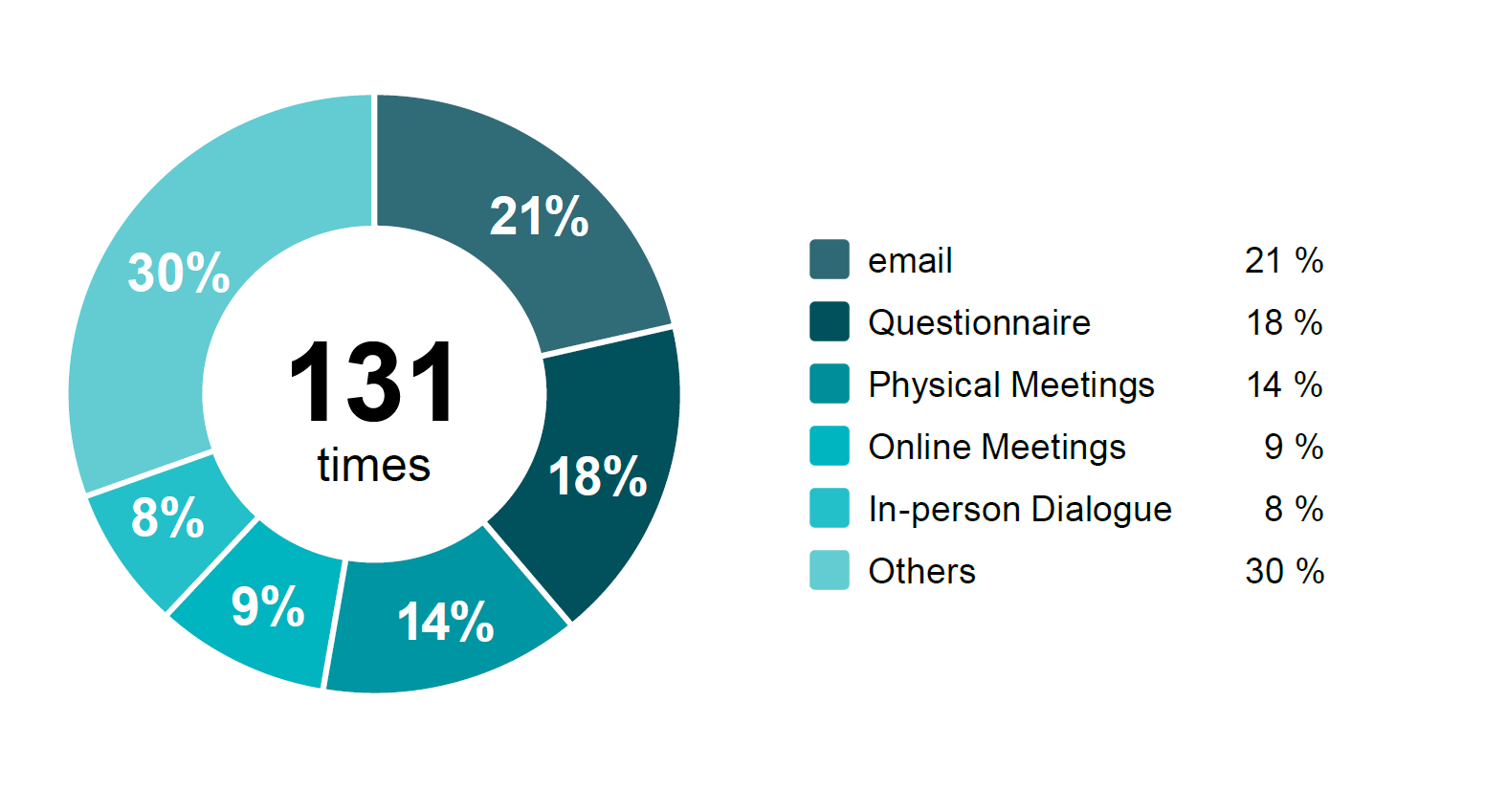
Ta Ya's primary channels for communicating with stakeholders in 2024 included: email, questionnaire surveys, physical meetings, video conferences, and in-person dialogue. By employing these communication channels, Ta Ya was able to select the most appropriate channel based on the characteristics of each stakeholder.
▼ Stakeholder Engagement Channels
Stakeholders
Category
Concerned issues
Method of communication
Frequency
Employees
Employees' health and safety
Talent recruitment and retention
Talent training and education
Harmony of labor-management relations
E-bulletin
Labor-management meetings
unscheduled
1 time/year
Customer
Customer relationship management
Product credibility and quality
Win-win relationship
Customer service hot lines
Project managers
depending on requirement
depending on project volume
Government
Compliance
Pollution prevention
Harmony of labor-management relations